Archive | Referrals RSS feed for this section

Pay for Relationships?

29 Feb

With the rise of various social networking sites like LinkedIn and Facebook, the promise of easy and immediate connections seems realized. I connect to you, you connect to them and since I can see that connection, I want to get connected to them, too. Bingo, I have a prospect! The problem is that it’s too easy and therefore not really that valuable for business networking.

The names of my contacts are not valuable – there a lots of places where someone else can find those names – JigSaw, LinkedIn, Hoovers, Spoke, the Yellow Pages, industry trade organizations to name a few. What’s valuable is my relationship to them. I’ve earned that relationship and it’s valuable.

Jay Deragon, in his The Relationship Economy blog, posted recently about whether Relationships are for $ale. He argues that, “You don’t sell relationships you build and earn them.” I’d suggest that you can’t buy relationships, either. Certainly not valuable ones.

Jay continues to say, “Sales techniques have changed over time to meet the ever increasing demands from informed customers. It has become imperative in today’s business environment to gain the trust of prospects and customers by first focusing on building relationships based on common affinities and objectives.”

And thus easy access to names can’t be the easy way to generate sales.

So if that’s not the easy way, then what is? As Jay points out, “People aren’t for sale (although many act as if they are) and neither are their relationships.” Valuable relationships are not put up on the web for all to see. Rather, they’re kept secure and hidden behind walls and only let out when there’s a very good reason.

What’s a good reason to let a valuable relationship be known? When you meet another sales rep you believe can add value to your customer. And by adding value to your customer, you’ve added value and trust to your relationship with that customer. You won’t sell that relationship because if your customer finds out, your trust is lost. But you have built a new relationship with that sales rep that translates to them introducing you to one of their customers. And then they gain value, too.

That’s what Inquisix is all about – we keep your RELATIONSHIP with contacts safe and hidden while introducing you to like-minded sales people who understand that relationships are earned, not sold or bought. Who agrees with me?

Happy Selling!

ABN = Always Be Networking

27 Feb

Note from the Editor – I saw Scott Ginsberg (aka the NameTagGuy) write a post over at RainToday and enjoyed it so much that I followed his suggestion #14 and asked him if Inquisix could re-post his entire article here. The content is Scott’s but the links are from Inquisix. Those of you who are familiar with Glengarry Glen Ross and Alec Baldwin’s ABC rule – Always Be Closing, will find our title familiar!

The Federal Bureau of Labor published a study a few years back that showed 70% of all new business comes from some form of networking. What other motivation do you need to start?

Below are fifty thoughts to help you on your way. Before you read on, remember: if you think you’re poor at networking, don’t worry, you’re not alone. It’s not a skill we are born with but one we have to learn.

1. Come to every networking event with three great questions ready to go. Be sure they begin with, “What’s the one thing?” “What’s your favorite?” and “What was the best part about?”

2. No matter where you go – the mall, church, out to dinner, the gym – have at least five business cards with you.

3. Be able to give an unforgettable personal introduction in 10 seconds, 30 seconds and 60 seconds.

4. When someone on the phone says, “May I ask who’s calling?” get excited. Say something unique that makes that person say, “Um, okay…please hold.” Be unexpected. Be cool. Be memorable.

5. Get Google alerts on yourself, your company, your area of expertise and your competition. If you don’t know what a Google alert is, just Google it.

6. Networking isn’t selling, marketing or cold calling. It’s the development and maintenance of mutually valuable relationships. Don’t mix these things up.

7. The most important four letters in the word “networking” are w-o-r-k, because that’s exactly what it takes.

8. If you give your business card to somebody and they don’t reply, “Hey, cool card!” get a new card.

9. When attending networking events, come early. Check out the nametags. See if you know anybody, or find people you’d like to meet.

10. Sit in the back so you can scan the room for specific people you’d like to connect with.

11. Email articles of interest, links or other cool stuff of value, (not spam), to people you’ve met.

12. Publish a newsletter or ezine. Interview people from your network and feature them as experts. They will take ownership of their inclusion and spread that publication to everyone they know.

13. Spend one hour a week reading and commenting on other people’s blogs. If you don’t know what a blog is, you’re in trouble.

14. When you read an article you like, email the author. Tell him what you liked about it and introduce yourself. He’ll usually write back.

15. Have an awesome email signature that gives people a reason to click over to your website. Just be careful not to have too much information included.

16. Get involved with social networking sites like LinkedIn, MySpace and Squidoo.

17. Remember that networking doesn’t have to be in person. The Internet is a great place to connect with people just like you! It’s called Internetworking. (Yep, I made that word up.)

18. Make your own words up. It’s really fun.

19. Have business lunches at least once a week.

20. Attend local events once a month.

21. Figure out where your target market hangs out (online and offline). Then hang out there.

22. Create your own regular “business hangout,” like a copy or coffee shop where you can regularly be found working, networking, reading or connecting with other professionals.

23. Talk to everybody. Don’t sell them; don’t probe them, just make friends. Make friends with everybody. Because people buy people first.

24. Take volunteer positions with organizations that are relevant to your industry. Be a visible leader to whom others can come to for help.

25. Every time you meet someone, write the letters H-I-C-H on their business card: how I can help. Then think of five ways to do so.

26. Go to Borders and spend one day a month reading books on networking, interpersonal communication and marketing. I highly recommend The Power of Approachability and How to be That Guy. (I hear the author is super cool.)

27. Publish articles or a blog or both based around your expertise. Use titles such as “Top Ten Ways,” “Essential Elements” and “Success Secrets,” that grab the reader’s attention. Publish them on http://www.blogger.com and http://www.ezinearticles.com.

28. Be funny, but don’t tell jokes.

29. Discover the CPI (Common Point of Interest) with everyone you meet.

30. Carry blank business cards with you in case someone forgot theirs. They’ll thank you.

31. Never leave the house without a pen and paper. Sounds dumb, right? It isn’t. It’s genius. Nobody keeps napkins with scribblings on them.

32. Every week, introduce two people you know who need to know each other.

33. Wear your nametag above your breastbone and make sure it’s visible from 10 feet away. Nobody cares what side of your chest it’s on. Just make it big. And if you don’t like wearing nametags, then you probably don’t like people knowing who you are, either.

34. It’s not who you know – it’s who knows you.

35. People will like you the minute they figure out how they are like you.

36. Fear not to entertain strangers for by so doing some may have entertained angels unaware. (Hebrews, 13:2)

37. If you don’t have http://www.yourname.com, get it. It’s ten bucks.

38. Find local professionals with whom you share common interests, customers, ideas and products. Introduce yourself to them, get together, share ideas and find ways to help each other.

39. Form a mastermind group. No more than four people. Meet regularly to set goals, keep each other accountable and brainstorm.

40. Also, set your own networking goals each month for:

* Events to attend

* People to meet

* Emails to write

* Calls to make

* Articles/physical mail to send

41. Go onto Google and type in “articles on networking.” Read on!

42. Speaking of Google, Google yourself regularly. Find out what people are saying about you. If you don’t show up, you’re in trouble.

43. If you think you don’t need to network, you are right. You don’t need to network: you must network!

44. Stop calling it networking. Ignore the title of this article. Networking – as a word – is tired and old and cliché and it makes people think you’re throwing around a bunch of cards trying to sell, sell, sell. No. All you’re doing is making friends. Not schmoozing, mingling or any of those stupid catch phrases. You’re making friends. That’s it. Friends. Make them every day.

45. If you think you are poor at networking, don’t worry. You’re not alone. But also remember that anyone can develop their networking skills. That’s right, skills. Because it’s not something you’re born with or just plain “good at.” Anyone can do it effectively. You simply need:

* To develop the attitude of approachability

* To read books on the subject

* To practice

46. When strangers ask, “How are you?” don’t say fine. You’re not fine. Nobody’s fine. Give a real answer that’s memorable and magnetic. I suggest, “Business is kicking ass!” or “Everything is beautiful!”

47. When someone asks where you’re from, don’t just say “Austin.” Use the H.O.T technique: “Oh, I’m from Austin, home of the best college football team in the country.” Get creative. Get unique. Watch what happens.

48. Put your person before your profession. Your personality before your position. Your individual before your industry.

49. Don’t be different – be unique. Don’t be friendly – be approachable. And don’t be memorable – be unforgettable.

50. Think about the last five “luckiest” business contacts you encountered. Figure out what you did right, realize that there is no such thing as luck, then repeat as often as possible.

About the author – Scott Ginsberg, aka “The Nametag Guy,” is the author of seven books and writes the #39th most popular marketing blog in the world. He is the creator of NametagTV, an Online Training Network that teaches businesspeople about approachability. For more info about books, speeches, customized online training programs or to Rent Scott’s Brain, call 314/256-1800 or email scott@hellomynameisscott.com.

First Review of the Inquisix Referral Exchange

21 Feb

Jan Visser over at SalesTeamTools has written the Jan Visser has written the first review of Inquisix: Do You Need Sales Leads Or Real Introductions To Your Ideal Prospects? I was a bit nervous about the review because we just started beta and we’re constantly updating the site. But as I hoped (and sort of expected, given Jan’s successful sales career), he immediately understood the value of the referrals and introductions Inquisix offers and how important it is that we protect the confidentiality of your contacts.

If you’re already an Inquisix member, please comment on his review.

If you’re not yet an Inquisix member, please read his review and then come join us!

Either way, if you have not already visited his site, you should.

Happy Selling!

Use Customers for References Not Referrals

16 Feb

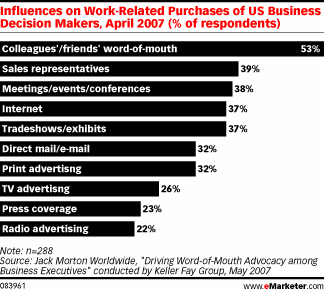
Two recent postings by Jan Visser and Paul McCord got me thinking about how to best use customers to increase your business. As the chart from eMarketer below says, business decisions are heavily influenced by colleagues’ word-of-mouth. Naturally, sales people try to get referrals from their customers to gain new ones. After all, they’re the best referral you can get! But as Paul pointed out, having your customer say, “Give so-and-so at this company a call and use my name” is often not much more than a cold call. Paul and I agree that it’s much better if they contact so-and-so and make the introduction directly. But they often won’t.

EmarketerChart

Why is this? Why won’t customers give you referrals? Or as Paul prefers to ask, “Why won’t customers make introductions for you?” There are several reasons but the primary one is that customers don’t really know how. It’s not in their DNA to voluntarily call someone up and tell them about your solution. However, they will respond to a request for feedback on your solution.

The chart says that the top influence on buying decisions is from colleagues. However, the chart does not suggest if the buyer received a call or made the call. I will bet that it’s the buyer making the call to their buddy, “Hey, do you have any thoughts on this product?” or “I have this problem, do you have any idea on how to solve it?” Since Customers often give references instead of making referrals, why not use them that way? If customers are uncomfortable making referrals/introductions then don’t use them that way. Get your referrals somewhere else and let your customer give the reference.

Expect your customers to receive calls on your behalf but not make them on your behalf.

Closing Ratio's

6 Feb

According to Colleen Francis in her blog, “Sell More, Work Less, Make More Money”

The closing ratio on cold calls is 75:1 while the closing ratio on referred leads is 4:1

CSO Insight’s 2007 Survey says that

Sales people spend 18% of their time cold calling.

With a 40-hour work week (yeah, if we only worked 40 hours), that’s over 7 hours of cold calling resulting in …. frustration.

In other words, if you spent those 7 hours working on referrals instead of cold calling, you’d close 18 times more deals!

Inquisix Networking Night SUCCESS

1 Feb

You know those days (no, those nights) leading up to the big presentation? I mean the BIG presentation, the one you’ve spent a year working up to? You’ve been planning the presentation, you’re looking forward to it, you’ve been role-playing what the other party is going to say, you’re prepping your team members on what to expect. And then it’s show-time. That’s how I felt walking into the room Tuesday night.

The setting was perfect – leather chairs, white linen table cloths and bookshelves lining the walls. Just the theme we want our website to convey – the members-only club where business is conducted over a handshake.

What a great turnout – it was standing room only. Thank you everyone who attended!

We started the night with some networking and introductions. For Dave and I, who’ve been talking and emailing with beta members, it was great to put member faces to names. Then Rick Roberge stood up and spoke about why giving referrals is better than exchanging referrals and both are better than asking for referrals. No real surprise here, Rick was preaching to the choir!

Then it was our turn to walk through the Inquisix solution and answer questions. Did we have a scripted demo? Of course but as it is the members who provide the content, I opened the discussion with, “What do you like, dislike, find confusing or think we missed the boat on?” Again, thank you members for your participation! The discussion was lively, it was informative and it was valuable. The members that had already used Inquisix to exchange referrals were leading the charge and helping us explain to the other members the how’s and why’s on getting started – upload your contacts, search for prospective customers, make referral requests and network with members with matches.

The unanimous decision – “The more you put into Inquisix the more you get out and it’s worth it!”

Presentations like this are why I’m in sales. Wow, what an endorphin kick to feel the energy of a group of people all arriving at the same decision by the end of the night! They are ready to embrace the Inquisix way of exchanging referrals and bring their sales colleagues into the fold, too.

Happy Selling!

NetworkingNight1-a NetworkingNight2 NetworkingNight3

left to right –

Inquisix Chief Sales Officer Michael Kreppein, Sales Coach Rick Roberge, Members Jim Glynn, Mark Tremblay, Andrew Adams, Bill Perrier, Mike Sachleben and Dan Wilcox

Cold Calling Works?

19 Jan

I found a new blog called SalesPractice today because there’s a big debate going on there about the effectiveness of Cold Calling. The author’s argument is essentially

If you have nothing else to do, why not get on the phone? What are you scared of?

The author is trying to counter the argument of the sales reps who’d rather do anything but cold call. He argues that if there’s not enough warm leads for them, instead of waiting for the phone to ring, they should pick it up and start dialing!

He then relates the story of a sales rep who cold-called Toyota and got a million dollar sale from it. I can relate my own cold calling success story when I cold-called a man who’s name I read in a magazine. He agreed to meet and within 5 months of V1 product release, I had my own million dollar deal from a F500 account. So does cold calling work? Of course it can. But I made hundreds (no, it was thousands) of cold calls to land that deal.

With success in hand, I was able to leverage that “halo account” sale into new customers, new referrals and new partnerships. Did I stop cold calling? Not right away but as my other sources of leads became stronger and stronger, I was then able to reduce my reliance on cold calling.

I agree with the author’s argument that you have to start somewhere. And you can’t use the excuse of “…cold calling does not work…” if you are not leveraging other lead sources correctly.

rotary phone

hiking

But does this mean cold calling works like the author claims? Sure, like walking from Boston to San Francisco is a fast method of getting there!

Collecting online friends like airlines miles

3 Jan

How many invitations are you getting a week to become a friend of someone on their online networking site? Invitations from social sites like Facebook and business sites like LinkedIn come to my mailbox daily. Then there’s MySpace and Going and MeetUp – the list goes on. It seems like a game or a treasure hunt, “…whoever collects the most friends win….” Remember in the early days of frequent flyer programs when you’d stand around saying, “Well I’m a 50K on United” and another salesrep would trump you by saying, “I have Platinum status on American!” Some of these people have collected online friends like they collect airline miles – I mean seriously, who really knows the 500 people they’re connected to in LinkedIn, for example?

I had these thoughts rattling around for a while but it was Seth Godin’s recent blog that got me to put it down on paper. Seth asks, “I wonder if there’s a more useful measure: who trusts you?”

I agree! Can you really know more than 150 people that well? Enough for them to trust you and vice-versa?

* eBay has seller ratings to help buyers determine if they can trust a seller.
* TrustPlus is a new site that lets you view the reputation of others while building your own reputation.
* Inquisix has member referral ratings for each of our members to help determine if members want to exchange referrals with each other.

Having lots of online friends is nice. Knowing who you can trust online is even better.

Get Productive, Drop Your P.I.T.A. Clients

27 Dec

We’ve all had a “PITA client”-perhaps more than one. (PITA stands for “pain in the a**.) A PITA will drain you, consume valuable resources, upset your team, squeeze you on price, pay slowly, and will never be satisfied with the results-even when you’ve agreed on the deliverables.

You know the warning signs. A PITA client will:

  • Nickel and dime you on price
  • Tell you they’re the decision makers when they’re not
  • Threaten you with your competitors
  • Make unreasonable demands, and expect fast, complete, and reliable delivery of your service
  • Not return phone calls

Talk about loss of productivity! PITAs are our biggest time wasters and they erode our profits. When we accept a PITA, it’s an opportunity cost-an opportunity lost to do business with our ideal clients. Yet companies continue to accept this bad business, all the while thinking it’s better than no business. But is it?

Sometimes it’s because we have a quota to meet, or our company insists we do a deal, or we think we can turn a bad situation into a good one. We’re dreaming. Bad business is bad business. Period.

Salespeople frequently say that they will sell to “anyone who fogs a mirror.” Avoid this kind of thinking. We shouldn’t target just “anyone.” “Anyone” all too frequently turns out to be the PITA customer.

Fire the PITA! Most of the time we can identify the PITA client before we even begin to work with them. Say no. It’s OK to walk away. In walking away from the PITA, you’ll have time to attract the kind of clients you really want, to do the work you love, and your productivity will soar!

Want more?
Listen to my podcast on Productivity on Salesopedia

Get the No More Cold Calling Self-Study Workbook

This self-study program equips you with referral strategies for finding clients who truly need your product or service.

Holiday Reading to Recharge Those Sales Batteries

19 Dec

For many of us, the end of the calendar year coincides with the end of the sales year. Have you made it yet? Will you (and your customers) enjoy the time between Christmas and New Year’s because you’ve already delivered your revenue committment to senior management?

Battery

When you need a quick break from all the holiday cheer and want to recharge those sales batteries with some quiet time then consider catching up on your sales reading and learning. But don’t have time to read all the new books on selling? Would you like the Cliff Notes versions instead? The Top Sales Experts website has just the booklet for you – and it’s co-authored by many of the top sales experts.

TopSalesExperts

I like “Leaving PowerPoint Behind and Make the Person-to-Person Sale” by Joanne Black, author of “No More Cold Calling” and guest blogger on this site.

Another good article is “A Glimpse at Sales 2.0 – the Potential and the Pitfall” by Keith Rosen. As salespeople, many of us started selling in the days laminated presentations and always making sure there was change in our pockets for the pay phone. Today we’re using web-based conferencing and wouldn’t be caught dead without our cell/PDA. So what’s next?

Read the article. Read them all – in the the order they interest you.

Which articles did you enjoy best?

Happy Selling!